The short version
- Researchers assessed 92 senior dogs at six-month intervals.
- The study describes ageing patterns; it does not test a treatment.
- New behavior changes deserve veterinary assessment rather than an assumption of normal ageing.
More than a number on a birthday cake
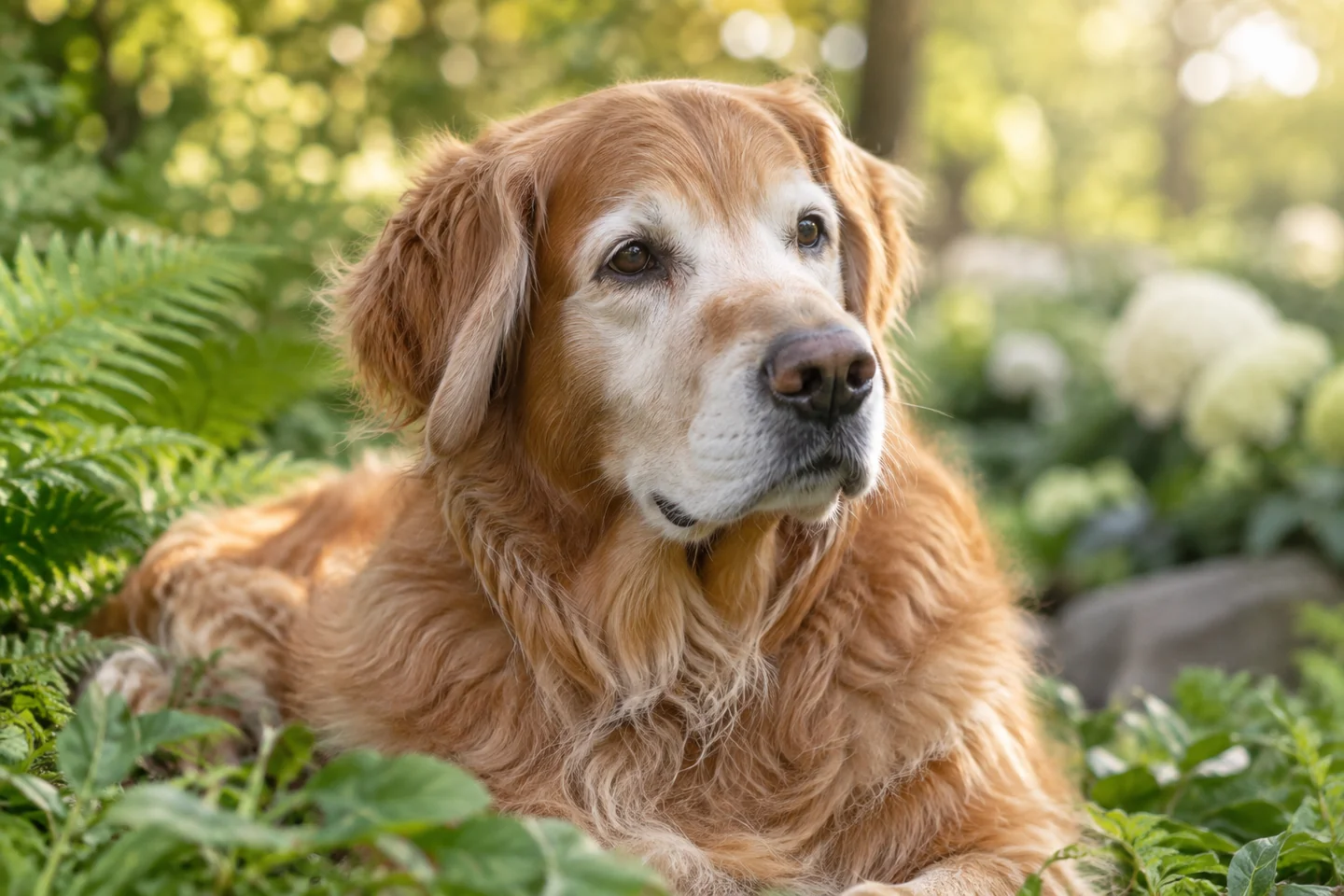
A grey muzzle tells you that a dog has lived a little. It cannot tell you exactly how that dog’s thinking will change next year. Research published online on 29 September in the Journal of Alzheimer’s Disease gives that distinction a closer look, following cognitive changes in 92 companion dogs aged eight and older.
The North Carolina State University team gathered information every six months, combining two caregiver questionnaires with five cognitive tests. Overall, scores declined with increasing age, but individual paths varied. The analysis identified groups with different trajectories. Age mattered across the population; it did not describe every dog’s course in the same way.
What the research can tell us
This was a study of change over time, rather than a snapshot comparing young and old dogs once. That makes it useful for asking how an individual’s performance evolves. It was not a treatment trial, and it does not establish that a particular food, supplement or activity prevents cognitive decline.
For an owner, this is a reason to resist easy comparisons. Two dogs of the same age can have very different daily experiences. A friend’s reassuring anecdote, or an alarming story online, cannot explain what is happening to your own companion. Observation is a starting point for questions, not a prediction.
Notice changes in your own companion
Cornell’s canine health guidance lists possible signs of cognitive dysfunction including disorientation, altered social interaction, changed sleep patterns, house-soiling, anxiety and difficulty with previously familiar learning. These are reasons to talk with a veterinarian, rather than grounds for diagnosing a dog from a checklist.
The American Animal Hospital Association likewise emphasizes a proper clinical assessment. Pain, organ disease and other conditions can produce overlapping changes. A history, examination and appropriate tests help a veterinary team decide what is happening. Describing a problem as ‘just old age’ can obscure something that deserves attention.
A useful record can be very ordinary
A practical way to prepare for an appointment is to note what changed, when it started and what was happening around it. ‘Woke twice during the night this week’ is more specific than ‘seems older’. If a behavior can be safely recorded without distressing the dog, a short video can help show the difference you are trying to describe.
Keep that record in perspective. It is a conversation aid, not a home scoring competition. Include comfortable days and favorite activities as well as difficulties. The aim is to give the veterinarian a fuller picture of daily life and to keep the dog’s comfort at the center of the discussion.
Make room for a gentler routine
Cornell’s senior-dog advice includes making unsafe areas inaccessible and respecting a dog’s preference for company or quiet. Its cognitive dysfunction guidance also describes individualized management involving enrichment, diet and, when appropriate, medication. Those decisions belong with a veterinary professional who knows the animal; this new study does not replace that care.
Our takeaway is a shift in attention: follow the dog in front of you, rather than an imagined standard for its age. A slower walk or a quieter afternoon can still hold plenty of pleasure. Good observation leaves room for both the changes that need help and the familiar joys that remain.
Sources & further reading
Our reporting is based on the sources below. Research findings and rules are described in their original context.
- Aging dogs exhibit heterogeneous cognitive decline trajectories: A longitudinal comparative model Journal of Alzheimer’s Disease / PubMed, 29 September 2026
- Cognitive dysfunction syndrome Cornell University College of Veterinary Medicine, Undated; accessed 2026-10-14
- Managing Cognitive Dysfunction and Behavioral Anxiety American Animal Hospital Association, 13 December 2022
- Senior dog dementia Cornell University College of Veterinary Medicine, Undated; accessed 2026-10-14
A story worth sharing?
Send a little perspective to another animal person.
Prepared with AI assistance and checked against the linked sources. Illustrations are AI-generated. Read our editorial standards.