The short version
- The four-week study compared food puzzles with non-food toys in 92 cats.
- Both groups improved, but there was no untreated comparison group.
- Enrichment includes safe places, resources and choice as well as play.
Start with a cat’s day
An indoor cat’s world is largely the world we arrange. This autumn’s feline behavior agenda offers a useful prompt to look at it from floor level. In its September announcement for the 3 October Cat Behaviour Conference, Hartpury University highlighted sessions on play, enrichment, stress and the relationship between chronic pain and behavior.
A study shared by the University of Copenhagen earlier this year gives that conversation a practical research angle. It examined whether regular enrichment around feeding times was associated with less attention-seeking behavior in cats with no or limited outdoor access. The comparison was refreshingly ordinary: food puzzles versus non-food toys.
What happened over four weeks
For four weeks, owners of 92 cats used either food puzzles or non-food toys around feeding times and reported their cats’ behavior.
Measured behaviors generally decreased in both groups, without a significant difference between the approaches. A familiar toy, then, should not automatically be dismissed in favor of a more elaborate purchase. The point of trying an activity is to learn something about your cat, not to acquire the most impressive collection of equipment.
An encouraging finding with limits
The trial compared two active approaches, so it did not include a group receiving neither. Reports also came from the cats’ owners. These features matter when interpreting the improvement: the study cannot isolate every possible reason that behavior changed. It provides a promising direction, rather than a universal fix for a cat waking someone at dawn.
The language we use matters too. Asking for attention is part of communicating with a person. The aim of enrichment should be a more satisfying life for the cat, not simply a quieter home for its human. A behavior that feels inconvenient may be a useful reason to examine the animal’s needs.
Think beyond buying another toy
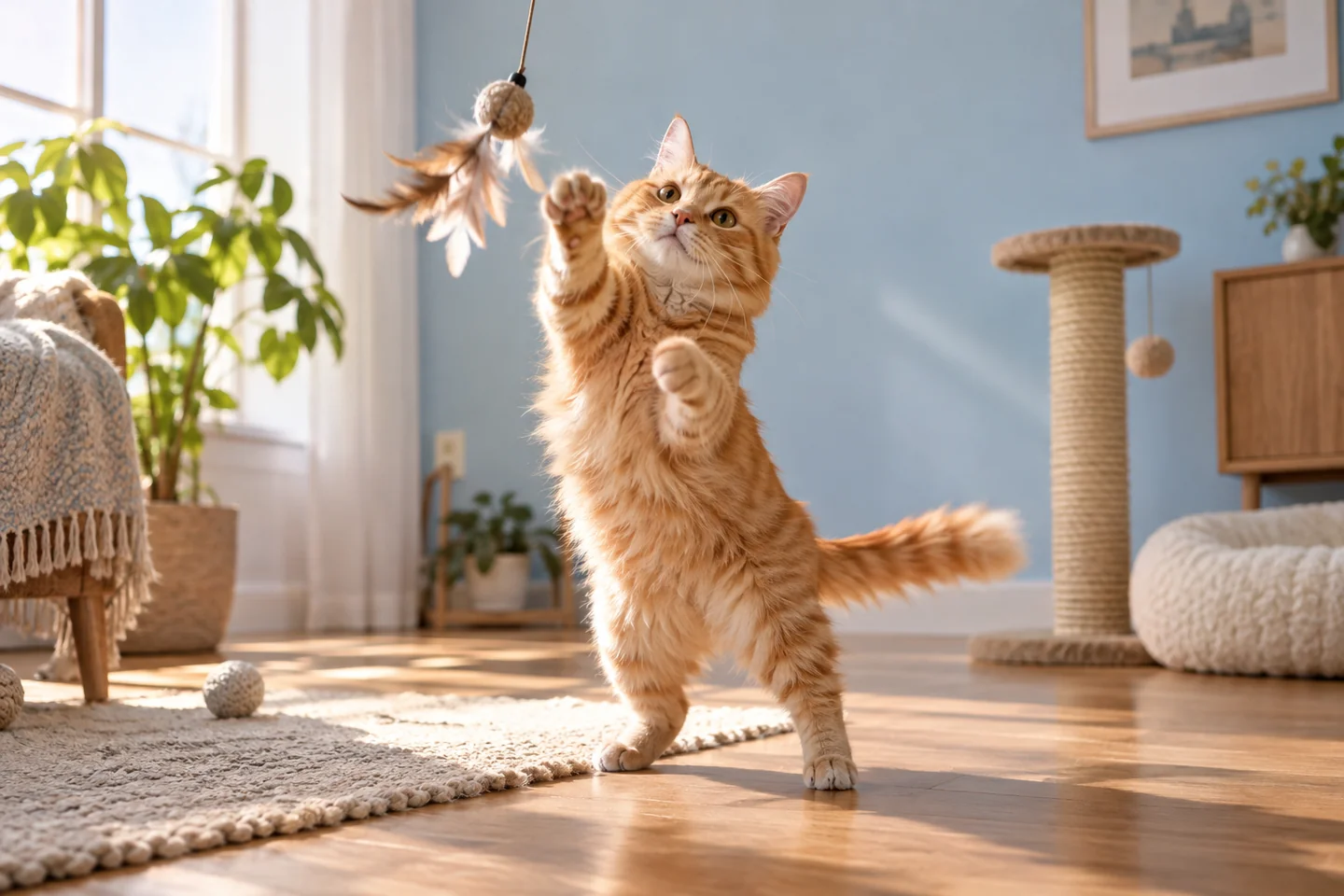
The AAFP and ISFM environmental guidance describes a broader picture: safe places, access to separated resources, opportunities for predatory play and positive interactions that respect the cat’s choices. Interactive toys can imitate prey, while food puzzles can make obtaining food an activity. Allowing a cat to catch a play target sometimes helps avoid frustration.
A thoughtful home does not need to look like a pet shop. Review where the cat rests, scratches, eats and retreats. In a shared household, check whether another animal can block access to something essential. The 2024 feline indoor/outdoor position statement also stresses vertical space, clean toileting areas and opportunities for simulated hunting and foraging.
Watch the response, then adjust
Our practical interpretation is to make one manageable change and pay attention to the cat’s response. An invitation to play should remain an invitation. A toy that is ignored is information about that animal, that moment or that setup, rather than a failed purchase or an ungrateful pet. Consistency is easier when the activity fits everyday life.
A sudden or persistent behavior change also merits veterinary advice. Hartpury’s conference announcement explicitly connected chronic pain with behavior and emotional wellbeing. Enrichment belongs within good care; it should not delay investigating discomfort. The appealing possibility in this year’s research is modest: ordinary, repeated opportunities to engage may help make an indoor day more rewarding.
Sources & further reading
Our reporting is based on the sources below. Research findings and rules are described in their original context.
- University lecturer to share expertise at international Cat Behaviour Conference 2026 Hartpury University, 4 September 2026
- Dealing with annoying cats: A randomised controlled trial of feeding-time enrichment University of Copenhagen / Applied Animal Behaviour Science, 23 April 2026
- Your Cat’s Environmental Needs: Practical Tips for Pet Owners AAFP and ISFM, 2013
- 2024 Indoor/Outdoor Lifestyle Position Statement Feline Veterinary Medical Association, 2024
A story worth sharing?
Send a little perspective to another animal person.
Prepared with AI assistance and checked against the linked sources. Illustrations are AI-generated. Read our editorial standards.